What Dashboards Can't See: The Tribal Knowledge Behind Your Security Stack
Security's most important context is rarely in dashboards or documents. It lives in people's heads: the workarounds, gaps, assumptions, fragile controls, and implementation realities that shape how a security stack actually works. Tribal Layer captures that knowledge and turns it into intelligence teams can act on.

Security teams do not have a tooling problem alone. They have a context problem.
Most organisations already have dashboards, inventories, alerts, CMDBs, architecture diagrams, ticketing systems, control frameworks, and risk registers. Yet when it comes to making good decisions about the security stack, teams still spend huge amounts of time asking the same basic questions.
Who owns this tool?
How is it actually implemented?
Which teams rely on it?
What capability are we paying for but not using?
What risk does everyone know about, but nobody has documented?
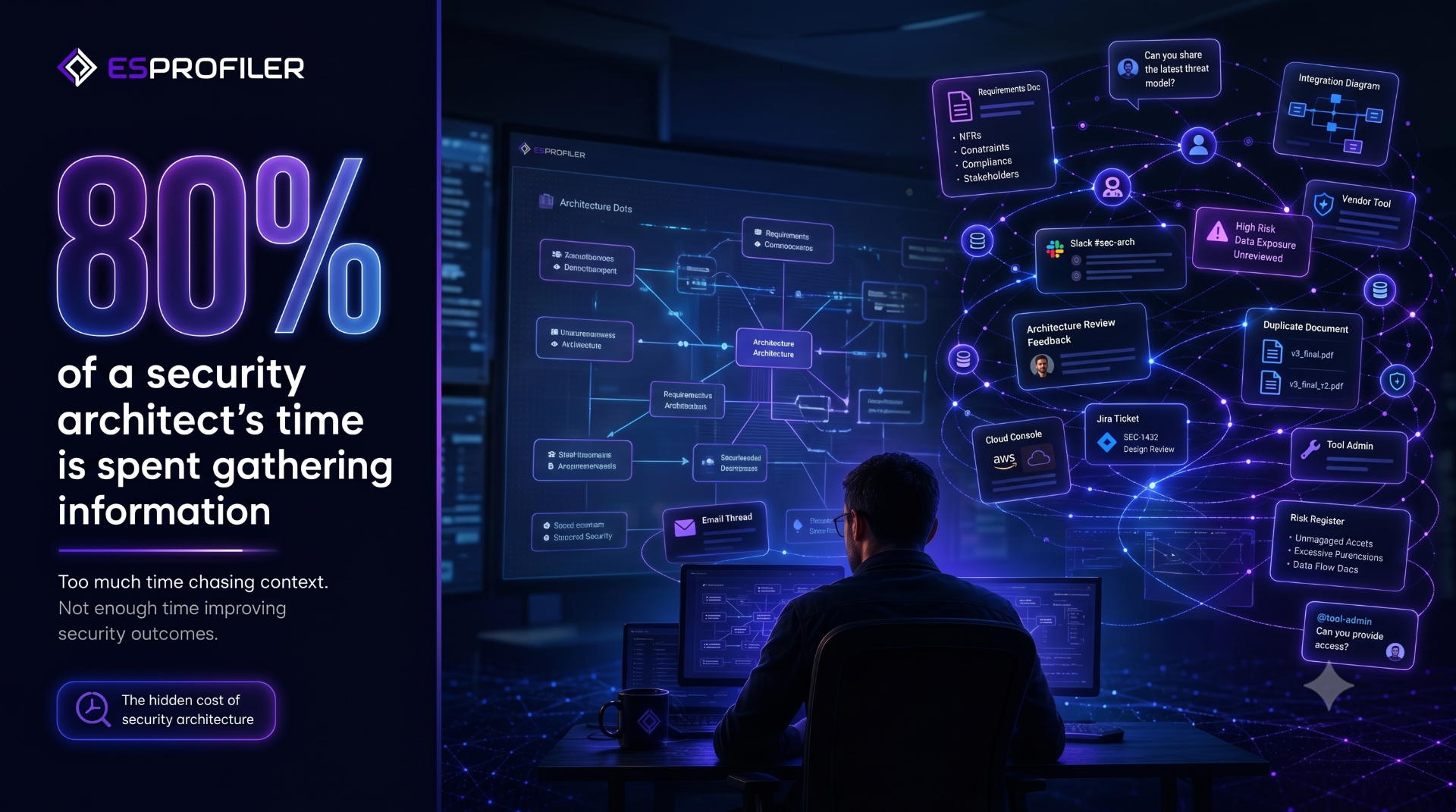
On a recent call, a CISO captured the problem. In a previous role leading security architecture, they estimated that around 80% of the team's time went on chasing and gathering information. Only 20% was spent applying expertise, synthesising what they had learned, and making decisions that improved security.
That ratio is backwards.
Security architects should not spend most of their time reconstructing the organisation's own reality. Their time should go on identifying risk, improving control coverage, rationalising the stack, guiding investment, and helping the business make better security decisions.
The challenge is that the most important context is rarely available in one place. It is scattered across people, teams, tools, tickets, spreadsheets, conversations, and assumptions.
It is tribal knowledge.
The Limits of Traditional Stack Analysis
Traditional security stack analysis can tell you what products exist. It can sometimes tell you which features are enabled, which controls are mapped, or which capabilities overlap. That is useful, but the gap between what a tool appears to do and what it actually does runs through all of it. A tool can be deployed without being fully implemented, a feature enabled without being effective, a control mapped without operating across the full estate. Two tools can offer the same capability on paper while neither meets the needs of the people who depend on it.
The reality of a security stack is shaped by how technology is used on the ground.
A SOC analyst may be satisfied with the alerting from a product, while the engineers responsible for it know it only covers part of the environment. A platform owner may depend on an integration that is fragile, undocumented, or maintained by one person. A control may have been implemented to satisfy a specific requirement, even though another tool in the stack now delivers the same outcome more effectively.
These are the details that change decisions. They are also the details that traditional tools struggle to see.
Why Tribal Knowledge Matters
Every security organisation runs on tribal knowledge. It lives with the people who operate the stack every day: SOC analysts, engineers, architects, administrators, product owners, compliance teams, and business stakeholders.
They know where the gaps are.
They know which alerts get ignored and which integrations break.
They know which products are critical, which are underused, and which create more operational burden than value.
This knowledge exists. It is simply rarely captured, structured, or connected to decision-making. When it stays undocumented, organisations decide using an incomplete picture. Product rationalisation becomes a spreadsheet exercise. Replacement planning becomes generic. Gap analysis misses operational reality. Control mapping becomes theoretical. Technology investments are made without fully understanding what teams actually need.
That is how exploitable gaps persist. The knowledge was there. It was just never surfaced in a way the organisation could act on.
Introducing Tribal Layer
Tribal Layer is ESProfiler's answer to this problem. It gives organisations AI agents that understand their security stack, their organisational context, and the directive they are working toward.
These agents engage with the people who own, operate, administer, and rely on each product. They conduct structured, adaptive interviews that go beyond generic questionnaires, establishing roles, understanding stakeholder needs, uncovering implementation realities, and documenting the context that traditional stack analysis cannot capture.
They go deeper and wider than a manual discovery process. They speak to more stakeholders. They adapt the conversation based on what they learn. They capture the fragile control, the muted alert, the undocumented workaround, the partial implementation, the missed integration, and the duplicated capability.
Most importantly, they turn that knowledge into structured intelligence.
From Conversations to Intelligence
Each Tribal Layer interview generates a detailed report. These reports are transformed into findings and documented against the relevant technologies in the customer's stack. Those findings are then aggregated into risk and opportunity signals within ESProfiler's wider intelligence layer.
This means product comparison, rationalisation, replacement planning, control mapping, and gap analysis are no longer generic exercises. They become grounded in the organisation's actual reality: not what the tool is supposed to do, not what the vendor says it can do, not what is written in an architecture diagram, but how the technology is actually implemented, used, depended on, and experienced across the organisation.
That is the difference between stack visibility and stack intelligence.
Giving Security Architects Their Time Back
Tribal Layer augments security architects rather than replacing them. Architects bring judgment, expertise, context, and accountability, but too much of their time is lost to information gathering before they can apply any of it.
Tribal Layer changes the ratio. Instead of spending 80% of the time chasing context and 20% making decisions, teams can redirect that effort toward the work that matters most: reducing risk, improving coverage, eliminating waste, and helping the organisation become more secure.
The goal is simple. Capture the human context behind the security stack, turn it into structured intelligence, and use it to make better security decisions.
The Gaps Traditional Tools Cannot See
Your most exploitable gaps are often the ones that do not show up neatly in dashboards. They live in assumptions, workarounds, partial deployments, missed requirements, fragile integrations, undocumented decisions, and knowledge held by a small number of people.
ESProfiler surfaces those gaps across the stack and turns them into a prioritised view of what matters most.
Fixed cost.
Fixed time.
Insights in weeks, not quarters.
That is what Tribal Layer makes possible. Security teams already have the knowledge they need to make better decisions. Tribal Layer helps them find it, structure it, and act on it.